2105, 2013

The journey has begun … (Beach Flags – Part 3)
By |May 21st, 2013|Dare to Dream, The Daily Process|0 Comments

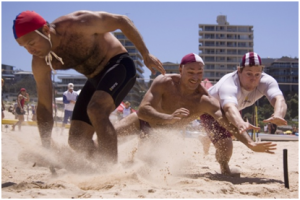
Here’s the next instalment of my Beach Flags journey.
You will recall that after reading and getting a lot out of my book ‘A Life That Counts’, my friend Jesper told me that he liked how my book was so practical, but he wanted even more. More details on HOW. HOW did I actually go after my own goals and dreams. What did I do – step-by-step.

So here’s part 3 to give you what you asked for. And using my latest goal and challenge – to become the World Champion (40-45 years) in Surf Life-Saving Beach Flags in 2014.

Step 6 – Learn from and model the best
I’m a massive believer in doing things right the first time and learning from the best. Why would I want to learn the wrong technique at the outset, only to have to try and change it down the track? Why wouldn’t I just learn it the correct way from the beginning – even if that takes a bit longer? Why wouldn’t I ask advice from people who know more? Why wouldn’t I suck all the knowledge that I could out of the best ?

Well that’s exactly what I went about doing ! And the best in the world in this event is Simon Harris. He is a multiple World Champion and (now) 10 time Australian Champion. 10 times ! Damn, that’s impressive.
 

And fortunately for me, Simon is one of those guys who is so good at what he does, that he doesn’t have anything to prove or any barriers to put up. He’s happy to share his knowledge with others. Thankyou Simon ! (As an aside I’ve found this to be the case with very successful people. They may be hard to track down or get their time and attention but when you do, they are only more than happy to share their wisdom, knowledge and insight. In contrast I have found that the less successful – those people who don’t want to help you, who defend their silos, who keep all their knowledge to themselves, who put you down to make themselves better etc – they’re those ‘small-minded’ people who don’t carry any of the big-mindedness of the truly successful who don’t have anything to prove or defend).

So I copied Simon. I modelled everything he did. I watched him on videos and copied it. Like a little kid.

And when I was up on the Gold Coast, where Simon is from, I got in contact with him (through a proper introduction) and went and did a training session with him. It was fantastic and so helpful.
And along the way I would occasionally text him with some questions. Or get him to watch me do a couple of starts if we were ever in the same competition and warming -up.

Yep – model the best !

Step 7 – Just do it. Talk is cheap
The thing is … I could have the best vision board in the world. Great goal-setting. I could have amazing contacts with World Champions like Simon and my coach Marty Lynch who help me and give me input. But at the end of the day, no matter which way you look at it – you’ve got to do the work. Plain and simple. Talk is cheap.

So this step was all about me just getting in and doing the work. I knew that I didn’t have a great training base under me for this years championships. I knew that I was only learning. I knew that I was underdone. But at this point I just needed to focus and do the training. So it was off to the gym to get stronger. Off to the track to get faster. Off to the physio and chiro to get over strains and injuries. Off to the bank to pay for it all ! 🙂 Into the kitchen to prepare stuff so I’d eat better. Down to the beach to practice the get-up and turn – the one I had watched so many times on the video but needed to figure out for myself. And off to competitions to get experience and practice.
And it is the same with any goal you’re going after. Talk is cheap. you’ve got to do the work. As Muhammad Ali said “The fight is won or lost far away from the witnesses – behind the lines, in the gym and out there on the road, long before I dance in those lights”.

Step 8 – Enjoying the journey
I’ve done a lot of sport over the years with rugby and bobsleigh. Too many to count but just over 20 years of serious sport. And the whole point of doing Beach Flags was to enjoy being fit and to enjoy the next challenge. To enjoy not having to cart a massive bobsleigh around everywhere. To enjoy doing a summer sport because both rugby and bobsleigh are winter sports. To enjoy being in good shape. To enjoy new experiences. To enjoy meeting new people and so on. And I am … and that is a big part of the journey. After all, if you don’t enjoy it, why would you do it ?

Step 9 – Test myself and see where I’m at
I had no specific goals this year. I am only 3 months into the sport and have a lot to learn. And I don’t really know what to expect. So doing competitions was more about the experience and learning rather than aiming for a particular result. But as is the case whenever you set goals, you need to see where you’re at so that you know if you’re on track to achieve your goal or not. Do you need to adjust? Are you ahead or behind of where you should be ? What have you learnt and need to learn ?

And for me this was competing in the State Championships and then the Austrlaian Championships.

I surprised myself in the State Titles by winning it and so it was off to the Nationals last month. (As much as I had no expectations this year having just begun this journey as I said, when you’re in competition that all flies out the window of course. You want to win ! Whether you’ve done the work to back up the will is another question entirely. (I love the quote that says “Plenty of people have the desire to be champions but only champions have the desire to prepare !”.
Anyway I entered the Australian Championships with no massive expectations, but still a secret goal to win a medal).

And guess what – good news – I did – I won silver !
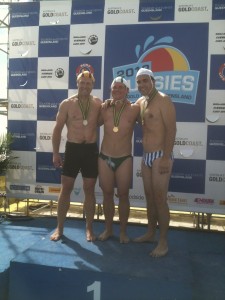

So it was a very happy Jeremy who came back to Sydney having enjoyed the whole experience and being happy with his performance. And the good news is that it has fired me up for next year – faster; in better shape; technically better; have stronger power to weight – just better !

bot-only-image

So now it is back into the hard work with 1 year to go until the next Australian Championships in Perth and then six months after that to the World Championships.

So stay tuned for the next instalments of the journey. I hope you’re enjoying them and learning at the same time.
705, 2013

The journey has begun … (Beach Flags – Part 2)

By |May 7th, 2013|Dare to Dream, Goal Setting|0 Comments

Remember my friend Jesper who has just read my book and asked me to show him more specific and actual steps about how I went after a goal – in my case, my goal to become World Masters Beach Flags champion in 2014. You can read the first post here in which I talk about figuring out this next challenge / goal and then figuring out why I wanted it.

Here’s the second instalment.

Step 3 – Structured Goal Setting
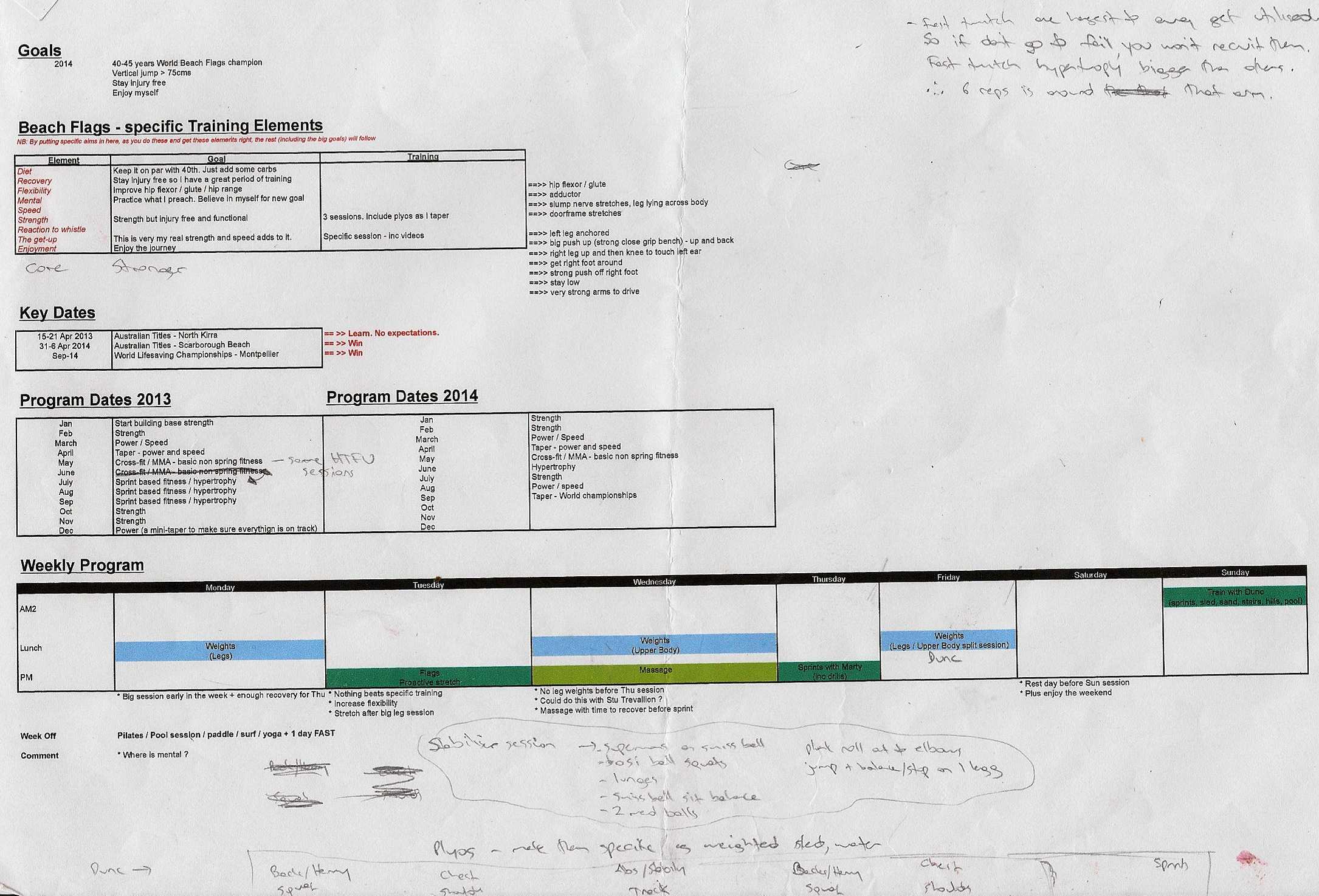
Here’s my actual goal setting for my 2014 Beach Flags goal. See below. You will see that I have:
1. The Big Goal – The big,shiny outcome goal written down for 2014

2. Yearly planning – I have the key dates written down over the next 18 months

3. Monthly planning – I have broken this down into each month for the 18 months leading up to the World Championships so I know generally what I’m doing in my training, what my aims are and where I’m heading

4.  Weekly planning – I have a weekly training schedule. What do I train on which day ? I spend a fair bit of time on this weekly plan to get it right as I want to make sure it fits into the other parts of my life eg I don’t want to train on a Friday night as I want to relax and chill out. I want a life too ! And when I don’t feel like it is all-consuming I never get that feeling of resenting my training. It adds to my life rather than takes away from my life. I plan to train at lunch on weekdays so it gives me a break from work and I then work better in the afternoons. And also because I am not good at training in the morning – I prefer just to get into work. I also make sure that the daily program makes sense by ensuring that I have enough recovery for various sessions, that I am training when I have energy (eg not at the end of the day if I can help it), and that I am doing enough training in each of the important training elements (speed, strength, flexibility, technical flags training) so that I ensure I am working on improving weaknesses, maintaining my strengths, are well-rounded in my training etc.

5. Daily planning – then each day for that particular session I will know what I am doing. What weights I am doing or what running session? This is a plan only though so it may change depending on how I am feeling / injuries etc. But the important thing is that it is still a plan. I don’t just turn up to training and then try and figure out what I am doing.

* Write my goals down
Tick.
(As the saying says “A goal is a dream written down or a dream with a deadline !” And surprisingly most people don’t do this as numerous studies have shown. For example see this blog post which describes a well known study by Harvard on goal-setting which Mark McCormack talks about in his book ‘What They don’t teach you at Harvard Business School’. The point – there’s a power in writing your goals down).

* SMARTR goal setting
Specific – at this stage I don’t have enough of these very specific milestone goals. I need to add these. They will be in terms of technique improvements, speed tests, weights I want to lift, diet etc.
Measurable – I will see how I am tracking at State and Australian titles this year. That will be a good measurement. But the more specific milestone goals will all be able to be measured of course.
Achievable – my big outcome goal of World Champion is absolutely achievable if I can stay in great shape and learn the technique from the best. But getting to this point of absolute belief is the topic of another blog post. Or read my book of course.
Regularly assessed – as I add more milestone goals they will be regularly assessed in accordance with the timing I put on them. Again – more need to get added here. But goal-setting is an ongoing process not a set and forget.
Timed – as above
Reward – the fitness and health I gather along the way is enough for me now as I have no big result expectations this year. But as I enter the next 2013/2014 season, as I have encouraged others, I will come up with a specific reward for winning the Australian title and then another one for winning the World Championships.


Step 4 – Support for my goals

Tick. I still train with my brakeman from the last Olympic season (Duncan Harvey) on Sundays to keep me training at that higher level as he is still in training for the upcoming Winter Olympics in Sochi.
I have a great family and partner who are supportive.
I have a coach on the beach flags side who knows his stuff. He is a multiple Masters World Champion himself and his son just won the open World Championships this year.

Step 5 – Get input on my plan
Tick. I always let other people critique my plan and I welcome their input. Sure, it is not cast in stone and will change over time anyway, but my goal-setting is nonetheless the big roadmap that I will follow. So for this reason I want knowledgeable people to look at it and make suggestions and comments to help me make it better. That is why there are scribbles on this page. The point – you can always learn and improve so input from the right people can be invaluable.


…  I hope this is helpful. Stay tuned for the next instalment shortly as the last few months have been busy leading into the Australian Championships which have just finished. So there’s more to share on this journey.


 bot-only-image

2304, 2013

The suspended coffee – paying it forward

By |April 23rd, 2013|A Life That Counts, Miscellaneous|0 Comments

I remember when I was writing my book A Life That Counts I was confronted with what my life actually stood for. Basically I had a great family, great friends, lived in a beautiful democratic country, and had spent my life pursuing sporting goals and working hard in banking and finance to effectively contribute to a share price improving.

bot-only-image

And in stark contrast I wrote about the issues of human trafficking and global poverty.

It all seemed so ridiculous.

Now I know you can’t always think like this, but it challenges me all the time. Whilst 1.4 billion people live on less than US$1.25 per day, I would throw around money for drycleaning and complain about the jetcat being late.

Then I came across this little story to warm my heart and encourage me to do little things along the way to doing greater things that make a difference.

“We enter a little coffeehouse with a friend of mine and give our order. While we’re approaching our table two people come in and they go to the counter :

‘Five coffees, please. Two of them for us and three suspended’
They pay for their order, take the two and leave. I ask my friend:
‘What are those ‘suspended’ coffees ?’
‘Wait for it and you will see’
Some more people enter. Two girls ask for one coffee each, pay and go. The next order was for seven coffees and it was made by three lawyers – three for them and four ‘suspended’. While I still wonder what’s the deal with those ‘suspended’ coffees I enjoy the sunny weather and the beautiful view towards the square infront of the café. Suddenly a man dressed in shabby clothes who looks like a beggar comes in throught the door and kindly asks ‘Do you have a suspended coffee ?’

It’s simple – people pay in advance for a coffee meant for someone who can not afford a warm bevarage. The tradition with the suspended coffees started in Naples, but it has spread all over the world and in some places you can order not only a suspended coffee, but also a sandwich or a whole meal.

Challenge / Thought
Don’t you love the idea? Wouldn’t it be wonderful to have such cafés or even grocery stores in every town where the less fortunate will find hope and support? If you own a business why don’t you offer something similar to your clients. As for me I’m determined  to find ways to pay it forward more. 

904, 2013

Bullying, yogi bear & the garbage man, pork chops & karate chops and … beauty

By |April 9th, 2013|Miscellaneous|1 Comment

Shane Koyczan was bullied a lot when he was a kid. So he took that pain and made this stunning video – a spoken poem.  It’s powerful and confronting. Its passionate and beautiful.

  • At 1:10, he talks about the unfair question grown-ups always asked when we were kids.
  • At 1:41, he walks through his career choices.
  • At 2:11, some adults tell him something awful.
  • At 3:00, he decides on an impossible career.
  • At 3:48, he blows my mind.
  • At 4:50, he quotes an line from a cartoon. I never knew how epic that line was.
  • At 6:00, the audience realizes something tragic and funny.
  • At 7:36, he rips my heart out.
  • At 8:41, something awful is said.
  • At 9:15, he preaches the truth.
  • At 10:00, he has a message to every kid who was ever bullied.
  • At 10:49, you have to do what he says.
  • At 11:28, he gets to the beautiful, beautiful point. And everybody gives him a standing ovation.

So if you’ve ever been bullied (and I was) then take heart from what Shane says. If you can’t see anything beautiful in yourself then use another mirror. Look harder. Stare longer. And adults were wrong when they said that “sticks and stones might break your bones but names would never hurt you”. Words can hurt deeply. But … the people that threw around those words have to be wrong because why else would you be here. Why else would something inside you push you to keep trying. And why would God have created just you with your unique personality, talents and gifts. You are not what you were called. You are beautiful for everything that God creates is good !

And to bullies out there – may you be challenged to use your tongue and words to build up not tear down. To magnify not diminish. To encourage not ridicule. To compliment not criticise. To not have to make yourself feel better by making others feel worse. As you grow up and mature you’ll realise that that is one of the marks of real strength and character.

And if you have dreams, then don’t let anyone define to you what they can be. Like Shane points out – so often we’re asked what we want to do or be. And then when we dare share those precious personal thoughts and dreams, we are so often shot down and told they are impossible, foolish, stupid, impractical, unrealistic. We are told what we can’t be or can’t do, instead of what we can be or can do. We are asked to accept the identity others want to give us or asked to accept their own limitations of what’s possible. Show me anyone who has achieved something great and left a mark on this life and I will show you someone who refused to be limited by what others told them. Instead they trod their own path … and the rest is history. May you be encouraged to do the same.


 bot-only-image

2603, 2013

Are you happy ? … some keys and truths to happiness

By |March 26th, 2013|Life lessons|0 Comments

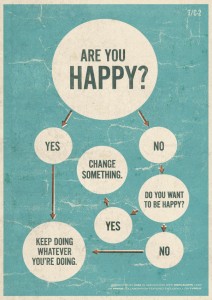
We all want to be happy. It’s natural. It’s on the top of all of our lists, no matter where in the world we live. It’s a good aim.

But many of us aren’t happy are we. And we chase after many things in life in search of it. Heck, there’s even an entire emerging branch of psychology (positive psychology) that has been coined out of the search of happiness and taking a proactive approach to fostering positive qualities in individuals.

The problem though isn’t in determining what we want, but more in figuring out how we go about attaining it.
What do we change? What will make us happy? How do we attain it?
Here’s a few interesting keys and truths around happiness to help you.


* Many things contribute to make us happy
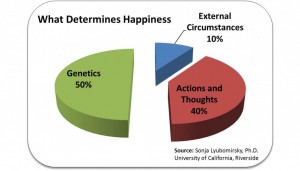
Sonja Lyubomirsky is a professor in the Department of Psychology at the University of California. She and her colleagues have done a lot of research into what makes us happy and strategies that can be used to increase happiness. (Sonja Lyubomirsky, David Schkade and Kennon M. Sheldon, “Pursuing Happiness: The Architecture of Sustainable Change“, 2005). According to this research, 50% of our happiness is genetically determined, 10% is determined by life’s circumstances and the remaining 40% is determined by our intentional activity ie what we think and what we do.

That a large part of our happiness is genetic is intriguing I know. (See this article in Forbes magazine for research done around studying identical twins where the common genetic factors played a large part in their happiness, not just the environmental differences in their lives. Or read more about the ‘happiness gene’ as described in this newspaper article). I guess though, that if genetic factors play a role in someone’s intelligence or athletic prowess, then it is not a stretch to believe that a happy disposition can be genetically predetermined.

But more importantly, let’s focus on the fact that a number of factors contribute to whether we’re happy or not. And

bot-only-image
 * Happiness is not just about material possessions or conditions

If you assume the above research is true, then what is means is that all that happiness that we seek through material possessions (the better car, bigger house, more money, the new pair of shoes, that new TV etc.) or through our external circumstances and conditions will only make a small difference in our reported levels of well being and life satisfaction (Lyubomirsky, 2007). Far less than what we’ve been led to believe.

It means if you were rich, had the perfect mate, and were in terrific health, you would only be 10% happier than if you were poor, single, and in bad shape physically. 

If your genetic set point favors misery, making a lot of money or even getting a rock hard body won’t tip the happiness scales in your favor. Sure, you may temporarily feel better following an achievement or gaining some material possession, such as a house, but within a year you’ll be back where you were before the changes occurred.

Surely that can’t be true? Are you telling me that I wouldn’t be happier after becoming a millionaire? Well, research proves otherwise. According to studies of lottery winners (see this article), as well as people who became paraplegics from an accident (see here), both groups returned to their previous level of happiness within less than a year. Or see this well known study where Masai herdsmen rated themselves and had the same happiness as the Forbes 400 richest Americans – see details here). Money wont buy you happiness. And most negative life experiences likewise have only a small impact on long-term satisfaction.

Do you see the point?  If you’re already miserable, your misery will continue even if you become a millionaire but if you’re happy in general, even upon becoming a paraplegic, you’ll eventually return to happiness after an adaptation phase.  We spend our lives trying to change our conditions in order to be happy, without realizing that it’s not working.


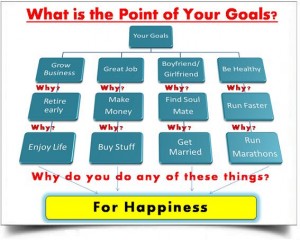
* Following your dreams / goals is good, but stop and think about the point of your goals

Have you been putting all of your energy into setting and chasing goals that you think will make you happy, but may not do so – or certainly not to the same degree as you thought.

Instead of putting almost all of your energy into chasing things that only slightly improve your happiness,  put your energy into that portion of happiness (40 %) that is in your control (what you do and what you think), and learn to harness it’s potential to bring about a happier life.


Conclusion

A number of factors contribute to our happiness. But clearly not the ones we think or that we spend most of our energy on.

Like me, you’re probably surprised that your genetics play such a big part in your level of happiness. But that is not the point – don’t be a slave to your genetic set point – anything can be improved. Just as you can learn more and become more intelligent, or lift more and get stronger – you’re capable of greater, more meaningful, happiness.

So put less focus on material possessions and your external circumstances (which don’t massively affect your level of happiness) and put more focus on your internal thoughts and intentions which make a bigger difference to your happiness (and are also most within your control). Find and use strategies to increase your happiness (exercise gratitude, enjoy pleasurable activities, improve your stress management skills, manage and harness your thoughts, make sure you are striving after the right goals for the right reasons etc).

And even if you never win the award for ‘Happiest Person on the Planet’, deepening your experience of happiness is reward enough !!!


1203, 2013

Pure inspiration VI – Narayanan Krishnan – living a life that counts by giving

By |March 12th, 2013|A Life That Counts|0 Comments

http://www.youtube.com/watch?v=wvJsAaqTuTM


In the last two chapters of my book ‘A Life That Counts‘ I write about enjoying the journey and of living a life of significance and purpose that makes a difference and leaves a legacy. Personally, that’s what I want to do. I want to go after my dreams with everything I have and without regret. I want to have a life where I am living my dreams. And I plan to always do this. But I don’t want my dreams to just be selfish. Because if they are – to what end ? I mean, let’s say I have all these personal goals and dreams and I achieve them. Great ! But have I made a difference to others? Am I leaving a legacy ? Am I living a life of real purpose and significance or just living a life of selfish self-fulfillment.

To me Narayanan Krishnan is one of those inspirations to live a life bigger than my own. To think outside of myself. To take myself out of the glass box that I live in. To wake up and get my hands dirtier. To make decisions that will lead me into the life I know I am meant to lead – in charity and philanthropy. Making the world a better place, one person at a time – with a soft heart, but strong head.

Challenge
“Start giving. See the joy of giving.” 
Narayanan Krishna 

bot-only-image

503, 2013

The top 5 regrets people have on their deathbeds

By |March 5th, 2013|A Life That Counts, Life lessons|0 Comments

I wanted to share with you a post by a woman named Bronnie Ware. She worked in palliative care for many years. Her patients were those who had gone home to die and she was with them for the last 3-12 weeks of their lives.  She wrote in her blog about regrets of the dying and I want to share them with you. They’re a good reminder of what’s important and valuable in life and what we should try to remember amidst the busyness and speed of our lives these days.


People grow a lot when they are faced with their own mortality. I learnt never to underestimate someone’s capacity for growth. Some changes were phenomenal. Each experienced a variety of emotions, as expected, denial, fear, anger, remorse, more denial and eventually acceptance. Every single patient found their peace before they departed though, every one of them. When questioned about any regrets they had or anything they would do differently, common themes surfaced again and again. Here are the most common five: 

1. I wish I’d had the courage to live a life true to myself, not the life others expected of me. 

This was the most common regret of all. When people realise that their life is almost over and look back clearly on it, it is easy to see how many dreams have gone unfulfilled. Most people had not honoured even a half of their dreams and had to die knowing that it was due to choices they had made, or not made.

It is very important to try and honour at least some of your dreams along the way. From the moment that you lose your health, it is too late. Health brings a freedom very few realise, until they no longer have it.

2. I wish I didn’t work so hard. 

This came from every male patient that I nursed. They missed their children’s youth and their partner’s companionship. Women also spoke of this regret. But as most were from an older generation, many of the female patients had not been breadwinners. All of the men I nursed deeply regretted spending so much of their lives on the treadmill of a work existence.

By simplifying your lifestyle and making conscious choices along the way, it is possible to not need the income that you think you do. And by creating more space in your life, you become happier and more open to new opportunities, ones more suited to your new lifestyle.

3. I wish I’d had the courage to express my feelings.

Many people suppressed their feelings in order to keep peace with others. As a result, they settled for a mediocre existence and never became who they were truly capable of becoming. Many developed illnesses relating to the bitterness and resentment they carried as a result.

We cannot control the reactions of others. However, although people may initially react when you change the way you are by speaking honestly, in the end it raises the relationship to a whole new and healthier level. Either that or it releases the unhealthy relationship from your life. Either way, you win.

4. I wish I had stayed in touch with my friends. 

Often they would not truly realise the full benefits of old friends until their dying weeks and it was not always possible to track them down. Many had become so caught up in their own lives that they had let golden friendships slip by over the years. There were many deep regrets about not giving friendships the time and effort that they deserved. Everyone misses their friends when they are dying.

It is common for anyone in a busy lifestyle to let friendships slip. But when you are faced with your approaching death, the physical details of life fall away. People do want to get their financial affairs in order if possible. But it is not money or status that holds the true importance for them. They want to get things in order more for the benefit of those they love. Usually though, they are too ill and weary to ever manage this task. It is all comes down to love and relationships in the end. That is all that remains in the final weeks, love and relationships.

5. I wish that I had let myself be happier. 

This is a surprisingly common one. Many did not realise until the end that happiness is a choice. They had stayed stuck in old patterns and habits. The so-called ‘comfort’ of familiarity overflowed into their emotions, as well as their physical lives. Fear of change had them pretending to others, and to their selves, that they were content. When deep within, they longed to laugh properly and have silliness in their life again.

When you are on your deathbed, what others think of you is a long way from your mind. How wonderful to be able to let go and smile again, long before you are dying.

Life is a choice. It is YOUR life. Choose consciously, choose wisely, choose honestly. Choose happiness.”


Challenge
 Perhaps we should live a little more like we were dying ! With the perspective that you tend to have on your deathbed.
So are there any regrets and life lessons of the dying that you can learn from ? Are there any things that you want to make a conscious choice and decision around (now) in order to change for the better.

bot-only-image

2602, 2013

The journey has begun … (Beach Flags – Part 1)

By |February 26th, 2013|Dare to Dream, Goal Setting|1 Comment

I was talking to a friend recently who had just read my book. He said that he would have loved to have seen even more detail on how I actually went after my goals. He liked how my book described the process and journey of chasing after a dream step-by-step. He liked the stories and examples and advice from the 10 incredible, successful and high-achieving contributors. He liked the psychology.

BUT, he wanted even more detail. What did I actually do as I journeyed towards competing in the Olympics. “Show me and tell me exactly” he said.

So Jesper, with that in mind, I thought I’d attempt to show you in a series of blogs over time, the exact and actual things I did and am doing along the journey to achieve my latest goal – to become the World Champion (40-45 years) in Surf Life-Saving Beach Flags in 2014. It may not be the Olympics, but I will hope to approach it with the same focus and strategy – even if the body isn’t what it used to be !!! So enjoy … and I trust this is interesting and helpful.

Step 1 – Find the Dream
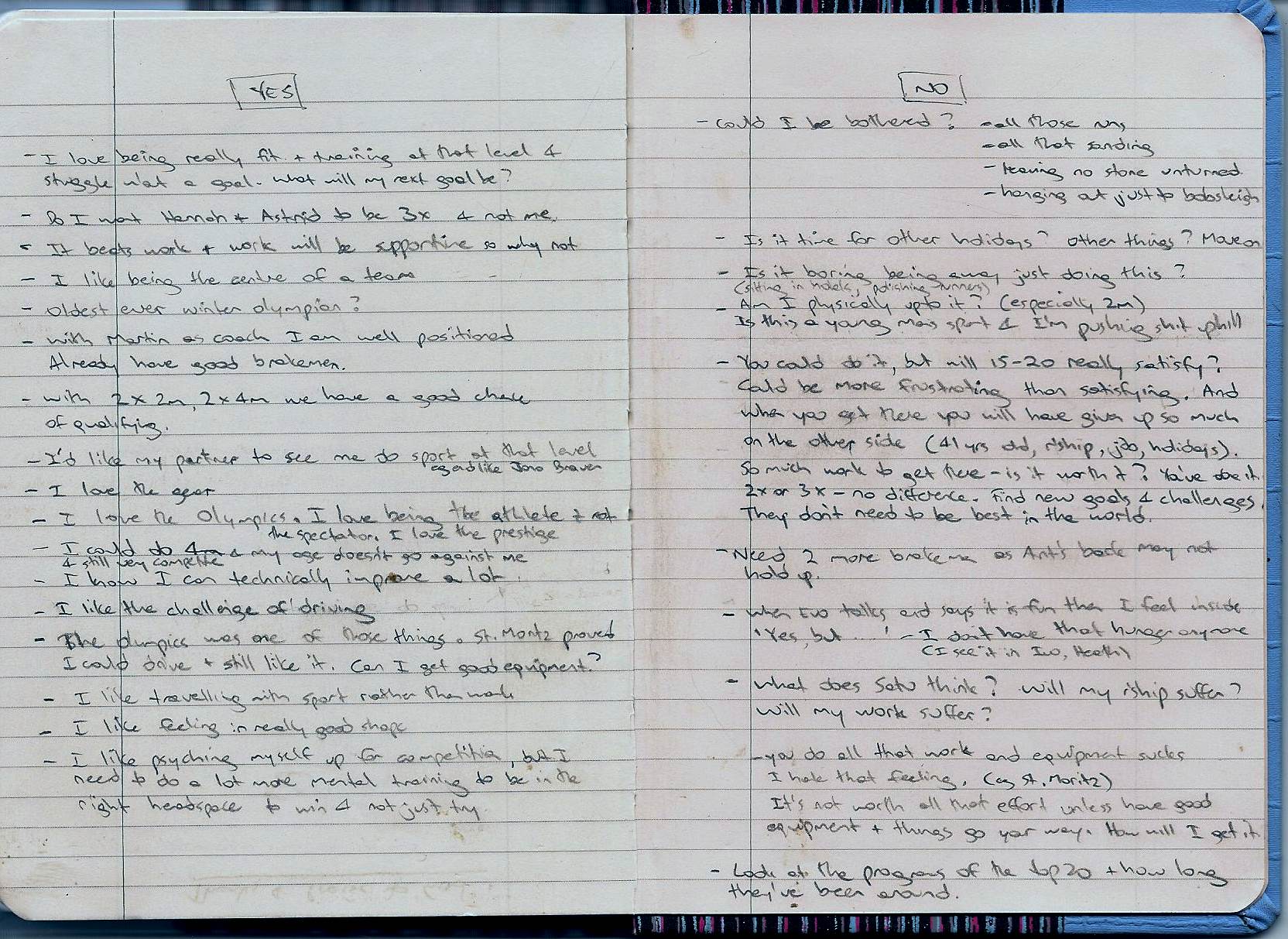
I love travelling on planes as I often take my journal and have time to scribble and ponder, write and dream, plan and scheme. It is that precious time when no one can get me and I often find clarity and organisation. And a recent flight back from Switzerland was no exception. I had just retired from bobsleigh and was just finally finding peace around not needing to go on for another Olympics and moving on to other things. So I was writing everything down to get further clarity and also to help me find that next challenge and goal. I’m a goal-oriented person and I didn’t want to just waste away into post-sport boredom, with no new goal to give me purpose, to excite me, to keep me fit and to stretch me. I’ve learnt to love the stretch. So I started writing and scribbling. The result of that was that over time I came up with my new goal. Part of the dream of what life might look like post elite Olympic level sport. Here are my scribbles …

bot-only-image


Step 2 – What is the big, bright and shiny goal ?
Remember, that you always need to have the big outcome goals. The thing you think about all the time that motivates you. The thing you can almost taste. That thing that is big, shiny and bright. Under those you then have your milestone goals – the smaller, systematic, more achievable goals that you will aim for and achieve (with hard work and strategy) along the way to your big outcome goal.
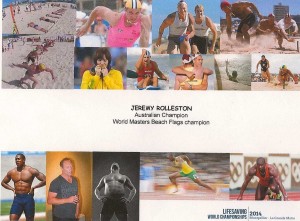
As I mentioned before, my latest goal that motivates and inspires me is to be the World Masters Beach Flags champion. This is a little collage I have in my training diary. It has the goal written on it as well as pictures that represent things to me. It is like a mini-vision Board for Beach Flags. To give me that extra little bit of motivation whenever I need it and keep the dream front and centre and vibrant.


Step 3 – What is my ‘Why’ ?
Remember in my book and workbook I talk about how ‘Knowing your Why’ is so important.  It provides your purpose and once we define it, every action takes on a more definite meaning. Simply put, if you don’t know why you want to do something then why would you do it. And if the why isn’t strong enough then why will you keep going when the going gets tough ? If your ‘why’ is not stronger than what it will cost you and the sacrifice and commitment needed to achieve it then you’ll give up. For example, consider these two people. One makes a new year’s eve commitment to get fitter to feel better or another person who has just been told by the doctor that if they don’t lose weight they will dies and leave their family without a father. Which person’s motivation do you think is stronger ? Which person’s ‘why’ do you think is clearer ? A person without a ‘why’ is like a ship without a rudder. No matter how hard you attempt to sail the rudderless ship, it goes nowhere. It churns ineffectively, without direction.

Or put another way, remember that knowing your ‘why’ is a way of tapping into your deep motivation for why you’re doing what you’re doing. Of engaging the Limbic system which is a separate area of the brain that controls our base emotions – things like fear, anger, sex-drive, attraction. That is, it controls things that happen without us even being consciously aware of it. For example, if you’re embarrassed, you blush – without even thinking of it. Which proves that our emotions often drive us, without our ‘conscious’ more rational part of the brain even having an input. So when we tap into our ‘why’ we are engaging these deep, powerful, ‘unconscious’, emotional drivers. And these are way more powerful than just trying to use your conscious will. (After all, if our conscious will was so effective we wouldn’t need to keep making the same New Years resolutions would we !).

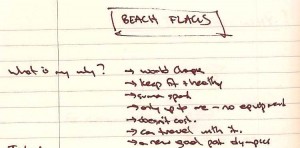
So what is my why ? What will it give me ? Why do I want to do beach flags and become World Masters champion ?


So there’s my first instalment. Stay tuned for more … I look forward to hearing your comments and feedback …

1202, 2013

A Father's Love

By |February 12th, 2013|Miscellaneous|0 Comments

http://www.youtube.com/watch?v=C8DLTW2OSrA

You can choose your friends but not your family.
And that can be a great thing or it can be a bad thing. For many, family is a source of frustration, anger, sadness, fighting and hurt. But that is not how it is meant to be.

Family is supposed to be a greenhouse of love, laughter, support, encouragement, learning, teaching, sharing and fun. And on that account, I feel very blessed. I come from a big family. Both my grandmothers on either side of my family were twins. And as a result no family event is small. But not only that, we are close. My immediate family is an incredible source of love and encouragement and support. We are a tight-knot family and love spending time together. If I can be half the parent that my parents have been, then I’ll be happy.

This video makes me count my blessings. I hope it does the same for you. To help us all be grateful and thankful for the family that we have. And if you’re family isn’t one of those blessings that you count, then my hope is that this video drives you to make your other family (your friends or the one you create with your wife/husband etc) how it is supposed to be – a place of love, support, caring, encouragement, nurturing … the way God intended it to be.


bot-only-image

502, 2013

Wanting something you've never had

By |February 5th, 2013|Action|0 Comments


It was the brainiac Albert Einstein who said the definition of insanity is doing the same thing over and over and expecting a different result. And he would know, after his countless experiments formed the basis for him publishing more than 300 scientific papers and 150 non-scientific works !

But, back to the point … in the same vein, it follows that if you want something you’ve never had, then you’ve got to do something you’ve never done.

The problem is, though, that it’s often as if there are invisible hands that hold us back when we want to do something we’ve never done. And this is what I want to focus in on today. So what are examples of these invisible hands? Well here’s some of them:

1. CHANGE
None of us like change. We are creatures of habit. If you want things to change you’re going to have to get to a point where you embrace change. Pretty obvious isn’t it. But easier said than done. Enough said ! To do something you’ve never done will require embracing change.

2. FEAR
We all have fears, and they come in many shapes and sizes. And they can emanate from many areas and for many reasons. But their effects are the same – doubt, hopelessness, nervousness, and the desire to shrink back rather than move forward. For example – fear of failure. Unlike kids, as adults, we often visualise the outcome already don’t we. So why would we begin or try something new or do something we’ve never done when we might embarrass ourselves and make a fool of ourselves? We see what could happen in the negative, rather than what could happen in the positive. The challenge is not to let that fear or those fears be a controlling influence on us and to cause us to stop moving forward in the direction of our dreams. It’s a choice. Plain and simple.

That’s a key point I’ve definitely discovered in my journey through life so far and through the opportunity I’ve had to meet and interview some incredible people as I did for my book. It is clear to me that people who accomplish incredible things face the very same fears as you and I do. The difference – they choose to take a different approach and mindset. They choose to see the glass half full. They choose to see the potential and possible outcome. They choose to dare to dream and follow those dreams. They choose to think bigger and broader about what’s possible and to have a go regardless of the ultimate outcome. They choose to see possibilities and dreams and to ask, ‘Why not?’ rather than see things and ask, ‘Why?’  They choose to believe the reasons why they’ll achieve their dream, not the reasons why they won’t achieve it. They make a conscious choice.

It reminds me of something Australian Rugby League player, Jason Stevens, said to me when interviewing him.
“Before a game, I was pretty much always fearful – especially in a big game like State of Origin, where there are millions watching. You have the expectations of fans, and you don’t want to let anybody down. For me, the feeling of fear never really went away, but what I learnt was to do things afraid.”


3. LIMITING MINDSETS
To do something we’ve never done requires a mental shift doesn’t it? A change of paradigm. Adopting a new view. Having a change of attitude. This is where it starts as our mindset effects our actions which then effects the outcome.
But this is easier said than done isn’t it? The crazy thing though is that it is often our own self-limitations that hold us back the most as opposed to limitations ‘imposed’ on us by others. It’s as if we’re chained up by our own choice. I mean, there’s not one person in a hundred who couldn’t write down his or her most exciting dream and not at the same time tell you, ‘It’s probably impossible; it’ll never happen.’ There’s not one person in a hundred who couldn’t give you good reasons why his or her dreams won’t come to pass and why he or she won’t achieve what he or she would like to. This is not a new problem. But, if you want something you’ve never had ==>> then you’ve got to do something you’ve never done ==> to do this you need to deal with your self-imposed limitations and adopt a new attitude that will lead to new behaviour.

As athletes we deal with self-imposed limiting mindsets all the time. If we don’t, we’ll never break through that invisible barrier and set a new ‘personal best’. Or we’ll never beat that person we’ve never beaten. So here’s a few ways myself and others have used to help us adopt an attitude that will then help us act differently and lead to new results.

A) Visualise the positive outcome – When I’m going to the gym for a ‘testing’ session, do you think I go up to the squat rack, look at the 272.5 kg ‘personal best’ on the bar and think, I can’t lift that weight once, let alone twice or three times!? Or Wow, that looks heavy; I’ve never lifted that weight before!? Of course not! If I did, I’d never progress as an athlete. I’d never push the boundaries, improve, and move forward. Instead, during the days leading up to that testing session, then while I’m warming up, and also immediately before I put the weight on my shoulders, I close my eyes and imagine myself lifting that weight. I tell myself, You can do this. You love this. You’re strong and powerful, and this is light. This is only an extra 5 kilograms, or 2 per cent. This is easy. I do this over and over to ensure I shatter that limiting mindset and put the positive image / mindset front and centre.

B) Foster unlimited thinking – Australia’s famous Paralympian and World Sportsperson of the Year, Michael Milton (whom I feature in my book used to inspire himself to unlimited thinking in the following way … ‘I remember that with my goal-setting, I used to grab a tape measure and put a mark of 2 metres and 8 centimetres – 2.08 metres – on the wall, which is the world high-jump record for an athlete with one leg. If you can imagine a guy hopping up to a bar and then hopping over a 2 metre bar without touching it, for me that was something that always inspired me and reminded me, when setting my goals, to set the bar high so that I made sure my goal was challenging enough yet realistic.’

C) Becoming aware of your thoughts – Olympic Gold medallist Lydia Lassila describes how before she could change her thoughts she first needed to become consciously aware of all the limiting thoughts going through her brain. “If you think about even one hour in a day, there are so many thoughts going through your mind; lots of garbage and lots of thoughts that don’t serve you . . . Becoming consciously aware of all these thoughts going through your head allows you to then analyse your beliefs . . . to be able to change your thinking.”


CHALLENGE

Your outcome (something you’ve never had) ==>>
is determined by your actions (doing something you’ve never done) ==>>

and your actions are first influenced by your thoughts

So the statement at the top of this post is true, but it actually starts with your thoughts.
So my challenge is to think about the invisible hands (your thoughts) that might be first holding you back.
Thoughts around 1) Change 2) Fears 3) Limiting Mindsets

bot-only-image

For more help and information read
A Life That Counts